Assemble your team
Assembling a quantum team will likely be challenging, given the shortage of people with experience in quantum computing. But are there strategies that make it easier? Are some roles even more critical in early stages, and are there best practices that can ensure the right people are on the team and know their roles? Successful leaders of quantum projects say "yes". The guidelines below have proven useful.
Key points
- Establish and develop a quantum team: Build applied quantum expertise by hiring and upskilling.
- Identify team objectives and mission to drive success and alignment.
- Build partnerships that can help you meet your expertise needs. Identify potential partners and members early. Develop the plan with your partners.
- Ensure that everyone knows their role in the larger endeavors.
- Establish a internal quantum champion to advocate for quantum computing and keep the organization current on advancements.
It is worth reiterating that for any client-facing quantum initiative (such as a QIC, startup, or quantum consulting group), it is a good idea to reach out to potential members/clients early on. This is especially important given the novel nature of quantum computing and the burgeoning quantum industry, since new membership agreements can take a long time to finalize.
Build and onboard a new quantum team
In some cases, launching a quantum project will mean hiring team personnel, and in other cases, you may already have internal expertise. The key thing is to identify the roles that must be filled. It is also important to have some idea of what full-time equivalent (FTE) is required for various roles, especially when some key players are splitting their time between projects.
This might differ according to organization and goals, but there are some very safe bets. Find your organization type below to see what roles have been critical to success in the past, and recommendations of minimum FTEs devoted to various roles. Some partnerships may require more.
Academic institution, research organization, or QIC
The following are critical roles:
Domain or application subject matter experts (SMEs): These are technical experts who develop code, demonstrate the current state of quantum computing, build demos and prototypes, and identify early applications. It is advised to have experts in both quantum computing and in the application area.
Project manager/team lead and support: These may cover a wide variety of support and management topics, including onboarding new members, supporting scientists with their work, delivering value to customers, and working on strategic initiatives. Other specialized activities include licensing/contract support, workflow, and compliance.
Program manager: A leadership role focused on technical implementation. This person manages technical aspects of internal and external projects, identifies potential research collaborations, and identifies application and research priorities. Other activities include managing research funds and grants, spearheading outreach, and generally supporting core research functions.
Administrator: A 'hub admin' is responsible for adding and removing new members to the provider, assigning groups and projects, and tracking usage for the organization. For more information on how administrators can create and track user accounts, visit the documentation.
Recommended minimum FTEs:
At year zero (just starting up) | Recommended minimum FTE |
|---|---|
| Subject matter expert | 1.0-1.5 FTE |
| Project manager | 1.5 FTE |
| Program manager | 1.0 FTE |
| Administrator | 1.0 FTE |
Enterprise organization
The following are critical roles:
Executive sponsor/advocate: An advocate for quantum computing (QC) within the leadership of the broader organization. This person has a vision of how QC will revolutionize their field, and keeps abreast of latest developments, but also manages expectations by accurately describing the capabilities and constraints of modern quantum computers.
Technical team (domain or application subject matter experts): These are technical experts who develop code, demonstrate the current state of quantum computing, build demos and prototypes, and identify early applications. It is advised to have experts in both quantum computing and in the application area.
Project manager/team lead and support: A leadership role focused on technical implementation. This person manages technical aspects of internal and external projects, identifies potential research collaborations, and identifies application and research priorities. Other activities include managing research funds and grants, spearheading outreach, and generally supporting core research functions.
Business SME: Team member(s) who explore partnership opportunities, develop the local quantum ecosystem, and who identify potential application areas and funding opportunities.
Recommended minimum FTEs:
At year zero (just starting up) | Recommended minimum FTE |
|---|---|
| Executive sponsor | 0.25 FTE |
| Project manager | 1.0 FTE |
| Subject matter expert | 2.0 FTE |
| Business SME | 1.0 FTE |
Startups
Startups have a wide variety of structures. Subject matter expertise and technical leadership will always be important. Here we also assume that business development is a priority.
Technical team (domain or application subject matter experts): These are technical experts who develop code, demonstrate the current state of quantum computing, build demos and prototypes, and identify early applications. It is advised to have experts in both quantum computing and in the application area.
Project manager/team lead and support: A leadership role focused on technical implementation. This person manages technical aspects of internal and external projects, identifies potential research collaborations, and identifies application and research priorities. Other activities include managing research funds and grants, spearheading outreach, and generally supporting core research functions.
Business SME: Team member(s) who explore partnership opportunities, develop the local quantum ecosystem, and identify potential application areas and funding opportunities.
Recommended minimum FTEs:
At year zero (just starting up) | Recommended minimum FTE |
|---|---|
| Project manager | 1.0 FTE |
| Subject matter expert | 2.0 FTE |
| Business SME | 1.0 FTE |
Global systems integrators
The following are critical roles:
Executive sponsor / advocate: An advocate for quantum computing within the leadership of the broader organization. This person has a vision of how QC will revolutionize their field, and keeps abreast of latest developments, but also manages expectations by accurately describing the capabilities and constraints of modern quantum computers.
Technical team (domain or application subject matter experts): These are technical experts who orchestrate the integration of quantum technologies into client systems. They should have expertise either in quantum computing or in the application area of the client.
Project manager/team lead and support: A leadership role focused on technical implementation. This person manages technical aspects of internal and external projects and identifies application priorities.
Business SME: Team member(s) who explore partnership opportunities, develop the local quantum ecosystem, and identify potential application areas and clients.
Recommended minimum FTEs:
At year zero (just starting up) | Recommended minimum FTE |
|---|---|
| Executive sponsor | 0.25 FTE |
| Project manager | 1.0 FTE |
| Subject matter expert | 2.0 FTE |
| Business SME | 1.0 FTE |
Courses and tutorials
Recommended learning material for developing quantum teams. Below are brief learning outcomes and intended audiences for each learning asset. Follow the links for more details on each.
- Audience: Accessible to anyone. Ideal for raising awareness across the broader institution, possibly not necessary for core team.
- Learning outcomes: Familiarity with quantum computing terminology, the state of the science, and awareness of a few application areas and areas of potential business value.
Basics of quantum information:
- Audience: Those seeking a deep theoretical foundation for quantum computing: students and early career scientists.
- Learning outcomes: Theoretical foundations of classical and quantum information, ability to describe quantum systems using linear algebra, describe multi-qubit systems and entanglement.
Quantum diagonalization algorithms:
- Audience: Those with strong quantum and computing backgrounds seeking to understand prominent and promising algorithms.
- Learning outcomes: Familiarity with algorithms like VQE, SQD, and SKQD, explain how different algorithms' costs scale with variables like problem size and the number of groups of commuting Pauli operators, and how to choose a good approach.
In addition to these self-guided courses, many tutorials on IBM Quantum® Platform showcase the latest algorithms and most powerful methods. Tutorials tend to be shorter assets, showing a streamlined implementation of a method. Here are a few of particular interest.
- Audience: For users fairly new to quantum computing.
- Learning outcomes: There are quantum correlations that are stronger than classical physics can explain, familiarity running a job using Qiskit.
Sample-based quantum diagonalization of a chemistry Hamiltonian:
- Audience: Those with strong quantum and computing backgrounds seeking to understand prominent and promising algorithms.
- Learning outcomes: How to use an SQD approach to find the ground state energy of a chemical system.
Sample-based Krylov quantum diagonalization of a fermionic lattice model:
- Audience: Those with strong quantum and computing backgrounds seeking to understand prominent and promising algorithms.
- Learning outcomes: Use the Krylov method from linear algebra, combine the speed of SQD with convergence guarantees from the Krylov method, know the conditions for convergence guarantees.
There are many other courses and tutorials available on IBM Quantum Platform. Check it out to see all the latest content!
Technical development best practices
Key points
- Follow dev/ops best practices such as CI/CD
- Develop incrementally, using agile methodology to scale up a technical approach and project
- Use simulators for debugging and benchmarking (Do not rely on simulators for too long in proof-of-concept (POC) work; they will not scale to utility)
- Reach out to IBM Quantum Technical support via the IBM Cloud Support Center for assistance with general technical support inquiries
- Use software features such as Qiskit addons and Qiskit Functions to fast-track technical development, learning, and discovery
Get the most out of quantum computing resources
Quantum computer access is a precious resource. It is important that technical practitioners use their allocated QPU time, and that they use it wisely. We recommend establishing expected good technical practices that ensure your team is using real quantum computers, scaling problems responsibly, and allocating time appropriately.
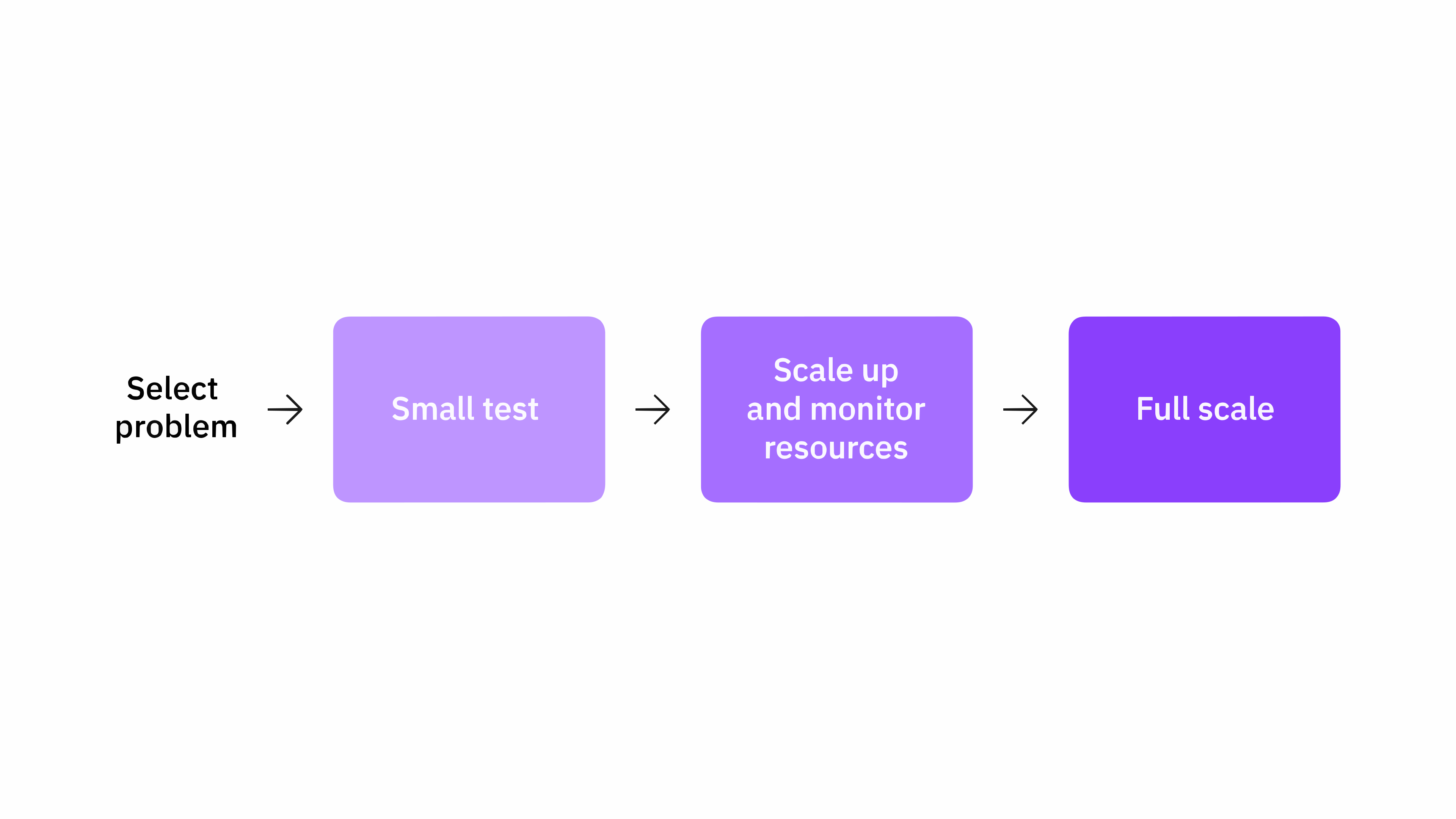
We recommend starting with small test problems, and increasing to the full-scale problem of interest in a few steps. This is important for reasons beyond resource allocation.
As IBM® quantum computers are becoming more powerful, results become increasingly difficult to check with classical computers. Indeed, no classical simulator can exactly simulate all functionality of a modern IBM quantum computer with over 100 qubits.
In the era of useful quantum computing, the role of simulators is mostly limited to debugging code. Benchmarking with smaller versions of your problem is one alternative when classical confirmation is no longer feasible.
In many cases, the scaling of your problem may be obvious, such as scaling a machine learning problem by increasing, for example, the number of data points, or the number of features. Another example is the scaling of quantum chemistry problems. It would be prudent for a technical practitioner to run example calculations on small molecules before tackling larger, more interesting systems.
In the next lessons, we address promoting your team's abilities to outside groups. Depending on your organization, this might mean grant writing and bringing in collaborators, or it might mean selling your services to clients.