Changelog
Last updated 5 June 2026
Keep up with the latest and greatest from Qiskit and IBM Quantum®!
5 June 2026
- Support for the Store instruction on IBM® QPUs - Now you can simplify complex classical computations in your quantum circuits with the Store instruction. Read more
29 May 2026
- Qiskit Code Assistant service discontinued - The preview service has been discontinued and the Visual Studio Code and JupyterLab extensions have been archived. Read more
28 May 2026
- New Classroom Accounts - Professors can now request a Classroom Account to manage and facilitate access for their students. With Classroom Accounts, students can use Open Plan resources without needing to provide personal credit card information. Read more
18 May 2026
- Introducing the Executor primitive - We're excited to announce the release of the new
Executorprimitive and a new version of the noise-learning helper class,NoiseLearnerV3, both of which were first previewed at QDC 2025. Read more
Jump to IBM Quantum Platform | Qiskit SDK | Qiskit Runtime client | Qiskit Runtime service | Qiskit Transpiler Service | Qiskit addons | Qiskit Functions | Qiskit Code Assistant
IBM Quantum Platform
This section summarizes the recent enhancements and new features for the new IBM Quantum Platform.
May 2026
-
Support for the Store instruction on IBM® QPUs - Now you can simplify complex classical computations in your quantum circuits with the Store instruction.
-
Compute a classical expression mid-circuit and save the result to a variable or register, which can then immediately control subsequent quantum gates. Instead of deeply nested inline expressions, you can break computations into named intermediate steps, so that complex classical feedback logic is easier to read and maintain. Common use cases include the following:
- Dynamic circuits with mid-circuit measurements and classical feedback
- Long-range entanglement preparation
- Complex conditional logic based on measurement outcomes
To use the store instruction, first ensure you're running the latest version of
qiskit-ibm-runtime(pip install --upgrade qiskit-ibm-runtime), then see the documentation for more information and an example.Note that before submitting jobs, you should verify compatibility with each primitive's options in the documentation: Sampler options | Estimator options | Executor options
-
- New Classroom Accounts: Professors can now request a Classroom Account to manage and facilitate access for their students. With Classroom Accounts, students can use Open Plan resources without needing to provide personal credit card information.
April 2026
-
New export options now available in IBM Quantum: Introducing new export capabilities that make it easier for account administrators to analyze, share, and work with their data.
-
New in the Analytics page:
- You can now export charts in SVG or PNG format.
- You can export all analytics data, including the data behind the charts, as CSV.
Find the export menu at the top-right corner of each card on the page.
-
New in the Access management page:
- Export both the Users table and the Access Groups table in CSV format.
Find the export menu at the top-right corner of the table.
-
-
New resources and hardware for Open Plan users: The IBM Quantum Open Plan now features new learning resources, new hardware, and a special one-time promotion for eligible users.
-
A new course, Designing and leading quantum projects, is now available. This course covers key topics for users looking to develop or secure funding for a quantum project, including early-stage planning, team roles and responsibilities, identifying meaningful use cases, defining measures of success, and a guide to grant writing best practices.
-
The Heron r2
ibm_kingston—one of our highest-performing quantum computers—is now available to all Open Plan users. -
Log 20 minutes of compute in any 12-month period and you can opt in to a special one-time offer: 180 minutes for the next 12 months.
With expanded runtime and new educational resources, users can run everything from introductory circuits to advanced hybrid workflows.
These efforts reflect our commitment to open access, open education, and open science in quantum computing. Read more: Doubling down on open-access quantum computing
-
Upcoming discontinuation of Qiskit Code Assistant service
On 29 May 2026, IBM Quantum will discontinue the preview Qiskit Code Assistant service and archive the supporting extensions for Visual Studio Code and JupyterLab.
Based on feedback and usage patterns, more users are running Qiskit Code Assistant models locally and working in editor integrations that are already part of their development workflow.
Qiskit Code Assistant models will remain available for local use. To continue using them, move to a local deployment and a community-supported editor integration or other local tooling.
For setup guidance, see the Qiskit Code Assistant guide.
Nighthawk arrives in the EU
Premium and Flex Plans now have early access to
ibm_berlin! It is the first IBM Quantum Nighthawk r1 QPU in the EU (eu-deregion) and the second Nighthawk in our global fleet, afteribm_miamiin the US (us-eastregion).ibm_berlinfeatures faster two-qubit gates thanibm_miami(68 ns versus 138 ns, median) while maintaining similar fleet-leading coherence (T of ~350 µs).Since its release, Nighthawk has enabled research in regimes where classical simulation becomes increasingly challenging. Specifically, its architecture supports hardware-efficient workflows that map naturally onto grid-based (lattice) models. See recent papers from Phasecraft and Volkswagen, and their collaborators, demonstrating simulation at scale on Nighthawk.
Please note that
ibm_berlinis currently an exploratory QPU that is still being tested and optimized as part of our continual cycles of learning. As such, it temporarily has the following limitations:- Default repetition time has been temporarily increased from 250 µs to 4 ms, which impacts QPU time required to execute workloads. Users can manually select a shorter repetition time, but performance might be degraded.
- Dynamic circuits are not yet supported, and quality of mid-circuit measurements is limited.
Upcoming retirements
As we expand EU capacity and roll out the latest Nighthawk and Heron processors,
ibm_brusselsandibm_strasbourgare scheduled to be retired on or around 30 April 2026.Once these QPUs are retired, they will no longer accept jobs. If your workflows target
ibm_brusselsoribm_strasbourg, please migrate to another active QPU ahead of the retirement date to take advantage of the latest systems. For guidance on retrieving data from past jobs, refer to the following documentation.ibm_torinois now retiredThe quantum computer
ibm_torinohas been retired and will no longer accept workload submissions. Any workloads that were already queued on this QPU might still be processed and return results.If you would like to retrieve job data from important workloads run on this QPU, refer to these instructions.
ibm_brussels and ibm_strasbourg are now retired
ibm_brusselsandibm_strasbourghave been retired and will no longer accept jobs.This change is part of the continued evolution and expansion of the IBM Quantum fleet in the EU, including the recently released Nighthawk QPU
ibm_berlinand the upgraded Heron r3 QPUibm_aachen. The global fleet has now fully transitioned away from Eagle, IBM Quantum's first utility‑scale processor family, introduced in 2021.If your workflows target
ibm_brusselsoribm_strasbourg, please migrate to another active QPU to take advantage of the latest hardware. For guidance on retrieving data from past jobs, refer to the documentation.March 2026
The EU gets its first Heron r3
Maintenance has been completed on
ibm_aachenand the QPU is now back online in the eu‑de region.ibm_aachenhas also been upgraded to be the first QPU in the EU to feature the latest Heron r3 processor. It is the third r3 in our global fleet, afteribm_bostonandibm_pittsburghin the US.Heron r3 continues to deliver improved error rates and overall system performance compared to Heron r2, demonstrating more reliable execution and better results for workloads. For example, on
ibm_aachen, we observe a large boost in (phase coherence time) from 150 µs to 250 µs. You can view metrics like these for all QPUs in the shared fleet on the Compute resources page.February 2026
ibm_torinoto retireThe
ibm_torinoQPU will retire on or around 1 April 2026. Once this QPU is retired, it will no longer accept jobs.If you would like to retrieve job data from important past jobs, please refer to the following documentation.
Increase in repetition delay time maximum
To provide more flexibility for users, we have expanded the allowable repetition delay time range from 20-500 µs to 20-2000 µs on our Heron and Eagle QPUs. The Nighthawk QPU delay time range continues to be 1000-4000 µs as previously announced. Note that if you choose to increase repetition delay (
rep_delay), it will have a direct impact on your execution time and capacity consumption, but it might improve the fidelity of certain circuits. The defaultrep_delayremains unchanged on all QPUs.You can find more information about repetition delay time, including how to change it, in Qubit initialization.
January 2026
-
The latest enhancements to the Compute resources page include the following:
-
Unified QPU view - All QPUs across regions are now displayed in a single table, making it easier to see status and calibrations of the shared fleet across the two regions. (You can still filter the Compute resources table by region using the funnel icon.)
-
Single maintenance schedule - The maintenance schedule is now at the top of the page, even when no events are currently planned.
-
"Instance access" details - When viewing a QPU's details, a new Instance access section shows all instances that grant the user access to that QPU for the selected account.
-
-
The first Nighthawk QPU and latest Heron QPU are now available. These two powerful new processors debuted at the IBM Quantum Developer Conference in November.
-
Premium and Flex Plans now have early access to
ibm_miami, the first IBM Quantum Nighthawk QPU. Our most advanced quantum processor to date, Nighthawk is a 120-qubit device with a square-lattice topology (218 couplers versus Heron's 176) that is designed to support more complex workloads. Nighthawk has the highest coherence of our fleet - even higher than what was reported at QDC - with a median T1 of 350 µs. -
Note that
ibm_miamiis currently an exploratory QPU that is still being tested and optimized as part of our continual cycles of learning. As such, it temporarily has the following limitations:- Default repetition time has been temporarily increased from 250 µs to 4 ms, which will impact QPU time required to execute workloads
- Dynamic circuits are not yet supported, and quality of mid-circuit measurements is limited
-
Additionally, Premium, Flex, and Pay-As-You-Go Plans now have access to
ibm_boston, our most performant IBM Quantum Heron r3 to date. It has demonstrated an EPLG at 100 qubits of 2.15e-3, with 57 of 176 possible two-qubit gates below the 1e-3 error level.
-
-
Introducing instance archiving for administrators on IBM Quantum Platform. With this update, administrators can archive any instance within their account. Archiving an instance ensures that:
- Collaborators retain access to results and QPU metrics, properties, and calibrations from past workloads.
- No new workloads can be submitted to the archived instance, preventing unintended usage.
- Archived instances do not subtract anything from your account's plan allocation.
- All archived instances are neatly organized under a dedicated "Archived" tab.
- Administrators can reactivate an instance at any time.
-
What's new at IBM Quantum - 4Q 2025
The What's New @ IBM Quantum Q4 2025 quarterly update is now live!
This convenient wrap-up aims to get you started exploring the latest hardware, software, research, and community events from IBM Quantum and our partner ecosystem.
Highlights include the recently deployed IBM Quantum Nighthawk and IBM Quantum Heron r3 QPUs, a call for submissions to the new open-source Quantum Advantage Tracker, and Qiskit C++, a new project designed to help HPC developers build production-grade quantum-centric supercomputing workflows.
This quarterly update also spotlights notable benchmarks, including:
- Best EPLG: 0.23% on
ibm_boston(IBM® Heron r3) - Best CLOPS: 330K+ across 7 QPUs
- Total available qubits: 2,477 across 17 QPUs
- Total papers using IBM Quantum or Qiskit: 5,635
Discover these updates and more.
Compute resources page update – Unified QPU view across regions
We’ve enhanced the Compute resources page! New features include the following:
-
Unified QPU view - All QPUs across regions are now displayed in a single table, making it easier to see status and calibrations of the shared fleet across the two regions.
-
Single maintenance schedule - The maintenance schedule is now at the top of the page, even when no events are currently planned.
-
Clearer "Instance Access" Details - When viewing a QPU's details, a new Instance access section shows all instances that grant you access to that QPU for the selected account.
You can still filter the Compute resources table by region using the funnel icon at the top of the table.
3 November 2025
The quantum computer
ibm_brisbanehas been retired and will no longer accept workload submissions. Any workloads that were already queued on these QPUs might still be processed and return results.If you would like to retrieve job data from important workloads run on this QPU, refer to these instructions.
October 2025
The IBM Quantum fleet welcomes
ibm_fezandibm_marrakeshto the Open Plan! All users can access these computers as of 27 October.A reminder that
ibm_brisbanewill retire on 3 Nov 2025, so plan your experiments accordingly.-
Learn quantum computing in your own language: We're excited to announce that translations are now available across all documentation and learning pages on IBM Quantum Platform! Translations have been the most-requested feature in user feedback, and now, quantum learning and development are more accessible than ever.
-
Translations of tutorials, courses, documentation, and announcements are now available in seven languages: French, German, Italian, Japanese, Korean, Portuguese, and Spanish.
-
Multilingual search: Use the search bar to find what you need in your preferred language.
-
Downloadable resources: Download resources such as guides or tutorials in the language that suits you best.
-
Localized API references: Explore the latest version of the API reference and REST APIs with fully translated documentation (current versions only).
-
Error messages & solutions: Understand issues faster with translated error codes and suggested solutions.
Find a translation error? Let us know! Submit a translation issue in our GitHub repo.
Note that there is a processing delay between the publication of new content and its translation, so you might only see the English version of recently released content for a few days while the translation is underway.
-
-
Learning in IBM Quantum Platform now has an updated home page to help you navigate the educational resources available, as well as two new catalog pages to help browse courses and modules. Check out the updates!
15 September 2025
The Unitary Foundation Quantum Open Source Software survey helps capture the needs and concerns of anyone who works with quantum software - including you! The survey results provide valuable feedback for our team of Qiskit developers, and helps us to understand the broader quantum software landscape.
If you have a few minutes, please share the link or consider filling it out today! The survey is open through 3 October 2025.
http://surveymonkey.com/r/QOSSSurvey25
1 September 2025
We plan to retire
ibm_brisbaneon or around 1 November 2025.Once this QPU is retired, it will no longer accept jobs. If any jobs are queued on the QPU at the time of its retirement, they will still run and return results. Please plan your experiments accordingly.
31 July 2025
Today, we are thrilled to announce the launch of ibm_pittsburgh, our first quantum computer powered by the new Heron Revision 3 (r3) QPU, and located in our Poughkeepsie quantum datacenter. r3 is the result of targeted improvements that directly impact coherence, gate fidelity, and readout performance.
The results speak for themselves, including an industry-leading ~350 us of T2 coherence; see the latest metrics on Pittsburgh on IBM Quantum Platform. This steady, measured progress is at the center of our strategy for delivering reliable and performant quantum computing.
As recently announced, today we retire one of our Eagle processors, ibm_sherbrooke. We invite you to migrate to our quantum computers powered by Heron processors, to take advantage of the lower error rates (approximately 5x lower EPLG) and faster gates (nearly 8x faster), leading to more performant circuits.
Together, let’s open the door to more complex algorithmic exploration and real-world applications.
24 July 2025
Quantum technology is advancing rapidly, and it can be challenging to keep up. To help you stay in the loop, we’ve put together a roundup featuring the newest tools, performance improvements, and updates from IBM Quantum. It includes links to code examples, documentation, and research to help you get the most out of our latest developments.
Learn what's new at IBM Quantum
27 June 2025
ibm_sherbrookewill now retire on or around 28 July 2025.Be sure to retrieve any job data from important past jobs before it is retired.
24 June 2025
- Profile page: Now you can find integrated profile details directly in the new platform. Find your profile by clicking on the user icon in the top right or visiting your profile page.
- Public backends: View a list of US backends without logging in, available on the updated Compute Resources page.
- Learning: Quantum computing courses have now been released in the upgraded platform, along with new educational modules designed to help teachers bring Qiskit into their classrooms. This is the first step towards migrating IBM Quantum Learning to the new platform, with more resources to be released in the coming weeks. Resources can be accessed without needing to log in at IBM Quantum Learning. Check out new and updated content, including Quantum diagonalization algorithms, Quantum computing in practice, and Qiskit in Classrooms modules like Quantum mechanics and Computer science.
- IBM Quantum Composer: The circuit-building Composer has now been migrated to the new platform. The experience is largely the same, except for files will no longer be stored in the platform, and will need to be downloaded locally. Find more details in the Composer documentation.
- Announcements: Now you can access news, software updates, and service alerts on the new platform. Click the bell icon in the top navigation bar or the link under Featured resources on the home page to visit the new Announcements page.
5 June 2025
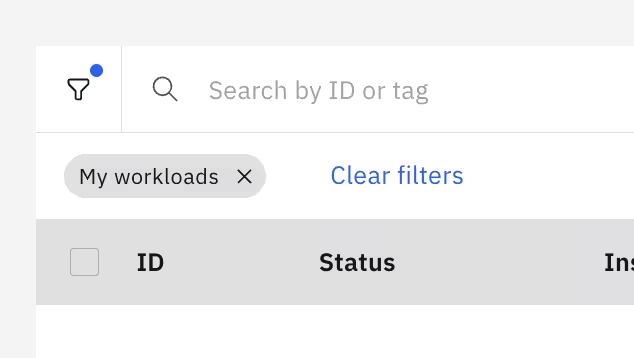
- Added instance job filter: The platform now displays only your workloads by default. On the dashboard, you will see only the latest workloads you have submitted to instances within your account.
- A new qiskit-ibm-runtime release, featuring:
- Support for private jobs for developers of Qiskit Functions
- A new channel for the platform that makes instance selection optional, which simplifies account setup and backend access by automatically checking all available instances. This update benefits users who manage multiple instances or prefer a streamlined workflow without specifying instance details each time. Developers and researchers working across various projects with different levels of access and multiple backends will find this especially helpful.
15 May 2025
Note: This is relevant to IBM Quantum Platform Classic (at https://quantum.ibm.com/) only.
If you are still using IBM Quantum Platform Classic at https://quantum.ibm.com, please note that it will no longer be accessible starting 1 July 2025. At that time, Open Plan access will only be available on the new Platform, and you will no longer have access to this platform or its data. Download your data and migrate to the new platform as soon as possible to avoid interruptions in your work. See the migration guide for more details.
Users of other plans (for example, Premium Plan or On-Prem Plan) should wait for specific instructions from their administrators before migrating.
8 May 2025
- Flex Plan, a new resource consumption offering, has been released.
- Tutorials are now available on the platform to help users with use-case exploration.
- The Qiskit Functions Catalog has launched on the platform.
- Updated Session OpenAPI schema:
backend_namefield is now nullable.
24 April 2025
- Instance limits: Individuals can view available time and usage, which displays alerts when approaching limits.
- Administrator permissions: Administrators can view overall usage, cycle period, and remaining time per plan in the Instances page.
- Search: Search is now integrated and available for filtering documentation content, including guides and API references.
- Billing: Pay-As-You-Go users can find a link to billing by clicking the overflow menu for each instance on the Instances page.
- New sign-in option: Sign-in with Google is now available on the sign-in page.
- Bug fixes:
- Addressed failed batch sessions for Open Plan users.
- Addressed batch sessions not closing properly.
- Improved platform stability by improving error handling and better recovery.
- Addressed an issue that prevented QPU metrics to be displayed for the QPUs in the eu-de region.
- Deprecation reminder: The deprecation date for IBM Quantum Platform Classic has been set for 1 July 2025.
21 April 2025
ibm_kyivhas been retired and will no longer accept workload submissions. Any workloads that were already queued on these QPUs might still be processed and return results.If you would like to retrieve job data from important workloads run on this QPU, refer to these instructions.
10 April 2025
- Updated navigation to remove duplicated pages:
- The Administration section has been renamed "Access management" and now only focuses on managing users and access groups.
- There is only one page each for managing instances and workloads; there are no longer separate pages for each in the Administration section. Instead, what you can view and manage on each page is dependent on your access and permissions.
- The analytics page (visible only to those with certain access) has been moved into the main navigation menu, to make it easier to find.
- Launched two new QPUs: ibm_aachen (eu-de region) and ibm_kingston (us-east region)
- Individuals who can view the analytics page can now filter the data to view information per plan.
- Administrators can now more easily add multiple individuals to an access group due to the addition of an existing account members table.
- Premium plan instance administrators can set the instance allocation as a usage limit, so that usage in those instances cannot exceed the time alloted. See the Set instance allocation limits guide for instructions.
- Note that the sunset date for IBM Quantum Platform Classic has been set for 1 July 2025.
9 April 2025
Two new 156Q Heron R2 QPUs, ibm_aachen, located in the EU region, and ibm_kingston, located in the US region, are now available.
View the systems you have access to with your selected instance in the Compute resources page on IBM Quantum Platform.
27 March 2025
-
Cost limits for Pay-As-You-Go Plan - Pay-As-You-Go Plan users with sufficient access can now view and edit maximum cost limits for their instances.
-
Job management updates - Now only administrators can delete workloads created by other users in an account, and collaborators will only be able to delete their own workloads.
-
Updated authentication error messages - Error messaging has been improved for account and authentication processes to reduce issues with signup flow. The Support page has been expanded with recommendations for troubleshooting and resolving common errors.
-
Increased default data retention - The default data retention period for the new IBM Quantum Platform has been increased to three years, up from one year on IBM Quantum Platform Classic.
-
Resolved inconsistent behavior due to caching - Some inconsistent behavior seen when updating instance limits, tags, and QPU resources has been resolved, which was due to caching.
For full details on the early access release and upcoming improvements, check out the blog.
25 March 2025
An IBM Quantum Network exclusive: Join us for our first quarterly IBM Quantum Product Updates Webinar, a series in which we unveil the latest advancements in our products and offerings, showcase partner use cases, and provide the opportunity for Q&A with quantum experts.
In the first segment, we will talk about the evolution coming to IBM Quantum Platform that is designed to enhance security, stability, and user experience. Our team will walk through the key updates, demonstrate new capabilities, and discuss how these improvements empower developers and users alike.
The second segment will feature the launch of three new and innovative Qiskit Functions in the Qiskit Functions Catalog. Each function provider will present their solution, highlighting its unique features, use cases, and impact on the broader ecosystem. Attendees will gain firsthand insights into how these Qiskit Functions can be leveraged for real-world applications.
26 February 2025
-
Today, we are releasing an early access version of the upgraded experience, and invite you to open an account and explore the new interface. We will continue to roll out updates over the coming months, with the end goal of creating an experience that looks and feels like the classic version of IBM Quantum Platform, but with greater functionality. We will eventually sunset IBM Quantum Platform classic, so stay tuned for updates.
-
Please note: If your IBM Quantum Platform access falls under a plan administrator (Premium Plan, On-Prem Plan, Startup Program, etc.), you will receive guided migration support through your administrator in the coming months. In the meantime, you are welcome to create a free Open Plan account to explore the new platform.
-
For full details on the early access release and upcoming improvements, check out the blog.
24 February 2025
Our inventory is getting a makeover, and we will be retiring the following QPUs on or around 18 April 2025:
- ibm_kyiv
ibm_sherbrookeUPDATE: ibm_sherbrooke will stay active for several more weeks after 18 April 2025.
Be sure to retrieve any job data from important past jobs before these QPUs are retired.
- Best EPLG: 0.23% on
Qiskit SDK v2.3
January 2026
-
Building on the momentum established across the v2.x series, which has centered on positioning Qiskit as the leading platform for hybrid quantum-HPC workflows, Qiskit SDK v2.3 delivers a significant expansion of the C API alongside faster, more flexible tools for building and optimizing quantum circuits.
Major updates include:
-
Custom transpiler passes in C - Write custom transpiler passes through Qiskit's C API using the new
QkDagobject and an expandedQkTargetobject, which enable step-by-step inspection, modification, and extension of the compilation process - without rebuilding the entire compiler pipeline. -
Faster hardware layout selection - Upgrades and Rust-driven performance enhancements to
VF2LayoutandVF2PostLayoutimprove the speed and scalability of circuit-to-hardware layout selection, reducing compilation overhead and improving fidelity on quantum hardware. -
New multi-qubit Pauli measurement - The new
PauliProductMeasurementinstruction enables joint projective measurement across multiple qubits in a single operation, unlocking compilation to Pauli-based computation - a common representation in fault-tolerant quantum computing. -
Improvements in early fault-tolerant transpilation - Performance and feature enhancements for transpilation to early fault-tolerant targets - especially Clifford+T targets - help users more efficiently build transpilation pipelines for future QPUs.
These capabilities give developers greater flexibility to customize quantum circuit optimizations and integrate with existing HPC workflows. Visit the blog for the full technical summary.
-
Wondering what has changed? Read the changelog and the v2.3 release notes.
To see the release notes for all versions, visit the Qiskit SDK release notes.
Qiskit Runtime client 0.46.0
April 2026
-
Introducing the Executor primitive: We're excited to announce the release of the new
Executorprimitive and a new version of the noise-learning helper class,NoiseLearnerV3, both of which were first previewed at QDC 2025.Together with Samplomatic, they make up the directed execution model, which provides full transparency and control to fine-tune your error mitigation workflow. The Probabilistic error cancellation with shaded lightcones tutorial, for example, demonstrates how this model is used to combine advanced techniques, including shaded lightcones, probabilistic error cancellation (PEC), Twirled Readout Error eXtinction (TREX), and measurement-based postselection, to further improve the result quality.
If you prefer a higher level of abstraction,
EstimatorV2in Qiskit Runtime continues to provide several built-in error mitigation and suppression techniques, which you can easily tune using theresilience_leveloption.To learn more, see the following guides:
Both of these new features are currently in beta and require
qiskit-ibm-runtimeversion 0.47.0 or higher.
March 2026
qiskit-ibm-runtimev0.46.0 has been released. View bug fixes and other notes since v0.45.0 in the release notes.
To see the release notes for all versions, visit the Qiskit Runtime client release notes.
Qiskit Runtime service
This summary of the latest changes to the Qiskit Runtime service applies to anyone using Qiskit Runtime, regardless of how you communicate with the service (by using qiskit-ibm-runtime or otherwise), or which version of the client SDK you use.
January 2026
- Directed execution model. This new execution model allows you to fine-tune error mitigation and other techniques without sacrificing performance by providing the ingredients to capture design intents on the client side, and shifting the costly generation of circuit variants to the server side. For example, you can use the Samplomatic library to define the exact layers in your circuits to apply Pauli-twirling and to inject noise. The new Executor primitive will then follow your directives to generate and execute the randomized circuit variants in Qiskit Runtime.
October 2025
-
The new dynamic circuits is now available to all users on all backends, except some QPUs under the On-Prem Plan.
With this new version, you can run dynamic circuits at utility scale. The initial release offers the following features:
- 75x execution speedup, thanks to the latest quantum execution stack
- Parallel branch execution, which reduces circuit duration and improves result quality
- Support for classical operations defined in Qiskit, with the exception of bit shift and arithmetic
- Support for stretch duration in delay instructions. This new type allows design intent to be captured at circuit construction time, and timing resolution at compile time
Additional features will be rolled out later this year.
See Classical feedforward and control flow and Deferred timing resolution using stretch for more information and code examples.
5 June 2025
- Now available: Early access to the new version of dynamic circuits on select QPUs. This new version will allow you to run dynamic circuits at utility scale and comes with improvements in speed, quality, and usability. Premium Plan and Flex Plan users interested in participating in this early access can contact us.
3 February 2025
- Pulse-level control on all IBM Quantum processors has been removed. Additionally, the pulse module is scheduled for removal in Qiskit SDK v2.0. Instead, you can use fractional gates that are now built into the Instruction Set Architecture (ISA). For full details and help migrating your code, refer to Migrate from Qiskit Pulse to fractional gates.
2 February 2025
-
Starting 2 June 2025 and continuing through the year, IBM Quantum will begin a gradual rollout of new features to dynamic circuits that will enable them at the utility scale. Improvements include the following:
- A 75x speedup in execution by using the Gen3 engine stack
- Parallel execution of branches, which reduces circuit duration and improves result quality
- Improvement in mid-circuit measurement
- Better integration with dynamical decoupling
- More visibility of circuit timing information
-
To accelerate the rollout, the following capabilities are now deprecated and will be no longer supported on or around 2 June 2025:
- The
while,for, andswitchcontrol flow constructs - The ability to use control flow instructions inside the body of a branch (as in, nested control flow)
- Conditional measurements
- The
7 January 2025
- The rollout of the Gen3 engine stack begins today. This engine stack gives a 75x speedup in execution. The rollout will be done on one QPU at a time, where a percentage of the jobs on the QPU will use the Gen3 path. You can also force the Gen3 path using the
gen3-turboexperimental option. Note that this engine stack is not compatible with fractional gates, pulse gates, or dynamic circuits.
15 October 2024
- Support for
backend.runhas ended.
1 October 2024
- Parameterized delay gates have been deprecated.
15 August 2024
- Probabilistic error amplification (PEA) error mitigation method is now available for Estimator V2. See the
ZneOptionsAPI reference for more details. - A new helper program
noise-learneris now available. It allows characterizing the noise processes affecting the gates in one or more circuits of interest, based on the Pauli-Lindblad noise model. The output noise model can then be passed to Estimator via thelayer_noise_modeloption. - V1 primitives are no longer supported.
3 July 2024
-
The following endpoints are deprecated and will be removed on or after 3 October 2024:
GET /stream/jobsandGET /stream/jobs/{id}. This removal has the following impacts:- After the endpoints are removed,
job.stream_results()andjob.interim_results()will be removed from the qiskit-ibm-runtime client. - Additional methods, such as
job.result()currently use the deprecated endpoints. Upgrade toqiskit_ibm_runtime0.25 or later before the endpoints are removed to avoid disruption.
- After the endpoints are removed,
18 June 2024
- The
optimization_leveloption is deprecated for Estimator V2 and will be removed no sooner than 30 September 2024.
3 June 2024
- Probabilistic error amplification (PEA) error mitigation method is now available as an experimental option for Estimator V2. See the
EstimatorOptionsAPI reference for more details.
28 March 2024
- Qiskit Runtime primitives now support OpenQASM 3 as the input format for circuits and standard JSON output format. See Qiskit Runtime REST API for examples.
-
Qiskit Transpiler Service client v0.15.2
January 2026
- See the v0.15.2 release notes.
To see the release notes for all versions, visit the Qiskit Transpiler Service client release notes.
-
Qiskit Transpiler Service client v0.3.0
- The Qiskit Transpiler Service leverages IBM Cloud® resources to provide users with the latest transpilation capabilities from the Qiskit SDK. It offers a Python library that helps users seamlessly integrate the service into their current Qiskit patterns and workflows. Perhaps most importantly, the service invites users to experiment with new and improved AI-powered transpiler passes — cutting-edge tools that might be faster and produce better results than traditional transpilation methods. Read the blog for more information.
-
Qiskit addons
-
We recently released two new addons that use classical resources to reduce the quantum resources needed for error mitigation:
-
Propagated noise absorption (PNA) is a technique for mitigating errors in expectation values by absorbing the inverses of the learned noise channels into observables using Pauli propagation.
-
The Shaded lightcones (SLC) addon uses classical simulations to more tightly bound the sensitivity to errors throughout the circuit. This allows for more efficient, targeted applications of Probabilistic Error Cancellation (PEC) with reduced variance.
-
Qiskit Functions
April 2026
- All API reference content for Qiskit Functions can now be found with other API reference documentation: Qiskit Functions API reference
18 July 2025
Qiskit Functions templates provide you with a modular pipeline that allows you to swap in new tools, methods, or configurations for your own custom experiments. All function templates are also readily deployable to Qiskit Serverless, where you can easily leverage classical compute as part of running your workflow. You can deploy your serverless package on your preferred cloud environment, or take advantage of the hosted service provided by IBM for Premium and Flex Plan users. Regardless of which option you choose, Qiskit Serverless helps to simplify execution and parallelize portions of your workflow.
Visit the Qiskit Functions templates guide to learn more, or read an overview of Qiskit Functions in the documentation.
5 June 2025
- We're excited to roll out two new functions for finance and optimization:
-
QUICK-PDE by ColibriTD allows users to solve certain differential equations for material deformation and computational fluid dynamics problems. For example, one team of researchers has already begun using the QUICK-PDE function to study the dynamics of novel reactive fluids developed to transfer heat more efficiently in a type of nuclear reactor known as Small Modular Reactors.
-
Quantum Portfolio Optimizer by Global Data Quantum enables quantitative finance researchers to back-test portfolio optimization strategies. Running on over 100 qubits, this function calculates a portfolio's Sharpe ratio versus return across a specified time period. Early users are exploring the optimizer's ability to evaluate historical performance of an investment strategy and to enable comparisons of different portfolios under similar conditions.
-
Check out the Qiskit Functions Catalog to request a free trial today.
4 June 2025
-
New updates
- Documentation for Singularity Machine Learning - Classification has been updated. View the Changelog.
16 May 2025
-
Over the coming weeks, every function will give detailed information to help you run, debug, and analyze your workflows. This includes:
- When jobs fail, you can use
job.error_message()to find specific error codes and messages to help you debug your workflows job.status()will give more information on what's happening while a Function isRUNNING, including:RUNNING: MAPPINGRUNNING: OPTIMIZING_FOR_HARDWARERUNNING: WAITING_FOR_QPURUNNING: EXECUTING_QPURUNNING: POST_PROCESSING
- Finally, after a Qiskit Function is complete, you can inspect how much time is spent across each stage with
job.result()['metadata']['resource_usage'], as in the following example.
- When jobs fail, you can use
{
      ...,
  "metadata": {
    "resource_usage": {
      {
        "RUNNING: MAPPING": {
          "CPU_TIME": seconds,
          "GPU_TIME": seconds,
          "QPU_TIME": seconds,
        },
        "RUNNING: OPTIMIZING_FOR_HARDWARE": {
          "CPU_TIME": seconds,
          "GPU_TIME": seconds,
          "QPU_TIME": seconds,
        },
        "RUNNING: WAITING_FOR_QPU": {
          "CPU_TIME": seconds,
          "GPU_TIME": seconds,
          "QPU_TIME": seconds,
        },
        "RUNNING: EXECUTING_QPU": {
          "CPU_TIME": seconds,
          "GPU_TIME": seconds,
          "QPU_TIME": seconds,
        },
        "RUNNING: POST_PROCESSING": {
          "CPU_TIME": seconds,
          "GPU_TIME": seconds,
          "QPU_TIME": seconds,
        },
      },
    }
  }
}
We're hoping these changes make it easier to use Qiskit Functions, and you can get started with free trials in the catalog today.
10 March 2025
-
Latest additions to the Qiskit Functions Catalog
To get started, explore the Qiskit Functions documentation.
16 September 2024
-
Introducing the Qiskit Functions preview, for IBM Quantum Premium Plan users. To get started,
pip install qiskit-ibm-catalogand explore the Qiskit Functions documentation. With the Qiskit Functions Catalog client, you can submit workloads to abstracted services designed to accelerate your research. Sign in with your existing IBM Quantum Platform credentials.The Qiskit Functions Catalog preview provides access to Premium Plan users to explore the available functions, including those written by IBM and those written by other members of our ecosystem. The catalog contains two kinds of functions: circuit functions and application functions.
-
Circuit functions provide a simplified interface for running circuits. They receive user-provided abstract circuits and observables as input, then manage synthesis, optimization, and execution of the representative ISA circuit. Circuit functions bring together the latest capabilities in transpilation, error suppression, and error mitigation to make utility-grade performance accessible out of the box. This allows computational scientists to focus on mapping their problems to circuits, rather than building the pattern for each problem from scratch.
-
Application functions cover higher-level tasks, like exploring algorithms and domain-specific use cases. Enterprise developers and data scientists may not have the background quantum information science knowledge for working with circuits, and instead hope to bring their domain knowledge to advance quantum computing algorithms and applications. With application functions, users can enter their classical inputs and receive solutions so they can more easily experiment with plugging quantum into their domain-specific workflows.
-
-
With the launch of the Qiskit Functions Catalog, Premium Plan developers can explore the IBM Circuit function. The IBM Circuit function includes the latest AI-powered extensions to Qiskit for circuit synthesis, optimization, and scheduling, as well as advanced error mitigation methods to return the most accurate estimations possible with today's hardware.
Users can purchase licenses for the following functions contributed by our partners at Q-CTRL, QEDMA, and Algorithmiq.
-
Circuit functions
- Q-CTRL is releasing a circuit function that applies AI-driven quantum control techniques, with which users can scale successfully to larger problems.
- Algorithmiq is releasing a circuit function that applies TEM (tensor-network error mitigation), an error mitigation method for obtaining estimators with fewer shots than the PEC (probabilistic error cancellation) method.
- QEDMA is releasing a circuit function that uses proprietary protocols for efficient and accurate characterization of the noisy QPU operations, and applies error suppression and error mitigation based on the characterization data.
-
Application functions
- Q-CTRL is releasing an optimization solver with which users can pass a graph or an objective, and receive solution costs.
- We're excited to roll out two new functions for finance and optimization:
Qiskit Code Assistant
29 May 2026
-
Qiskit Code Assistant service discontinued - The preview service has been discontinued and the Visual Studio Code and JupyterLab extensions have been archived.
Based on feedback and usage patterns, more users are running Qiskit Code Assistant models locally and working in editor integrations that are already part of their development workflow.
Qiskit Code Assistant models remain available for local use. See the Qiskit Code Assistant documentation for more information.
28 October 2025
-
We have updated the model available in the service to the newer
mistral-small-3.2-24b-qiskitmodel -
We have open-sourced two new models for local inference in Hugging Face:
For more details on Qiskit Code Assistant, see the documentation.
-